+1 (917) 764-4992

Login

The Holy Grail of International Education Finance: A Glossary for the Real World

Stop guessing what 'Gross' or 'RCTI' means. Our mega-post decodes international education finance jargon for agents and schools. Master your money and save today.

Raphael Arias
Raphael Arias
12 Jan 2026
The Holy Grail of International Education Finance: A Glossary for the Real World

You know that feeling when you walk into a mechanic’s shop, and they start throwing around words like “differential” or “catalytic converter,” and you just nod your head, hoping it won’t cost a fortune?

That’s exactly how most people feel about international education finance.

If you’re an education agent, a university admissions officer, or someone running the accounts for a language school, you deal with this every single day. You’re moving money across borders, juggling commissions, and trying to explain to a panicked parent why the amount they sent isn’t the amount that arrived.

It’s stressful. Honestly, it’s a headache.

But here’s the thing: the finance world loves its jargon. It acts like a gatekeeper. If you don’t speak the language, you feel powerless. But once you strip away the fancy syllables, most of these concepts are actually pretty simple. They’re just everyday money problems wearing a suit and tie.

So, let’s clear the air. We are going to build the ultimate cheat sheet. We’re going way beyond the basics. We’re talking about commission splits, the nuances of Xero, the “point of no return” for student fees, and why nobody uses fixed book rates anymore.

Grab a coffee. This is the big one.

Part 1: The Movement of Money (Getting Paid)

Gross Amount vs. Net Amount: The “Who Ate My Sandwich?” Debate

This is the number one source of arguments between agents and schools.

  • Gross Amount: The sticker price. The full tuition fee on the invoice.
  • Net Amount: What actually lands in the bank account after everyone takes a bite (bank fees, intermediary charges, and agent commissions deducted at source).

The Conflict: If an agent deducts commission before sending the tuition, the school receives the Net Amount. If the school’s software expects the Gross Amount, it flags an “underpayment.” It’s usually just a reconciliation issue, but it causes a lot of panic emails.

Remittance

It sounds like something from a Victorian novel, doesn’t it? In reality, a remittance is just a sum of money sent as payment. In our industry, it almost always refers to cross-border transfers. The trick isn’t the remittance itself; it’s the data attached to it (or lack thereof).

The SWIFT Codes: BEN, SHA, and OUR

When a student sends a wire transfer, they have to choose who pays the fees.

  • BEN (Beneficiary Pays): The school pays the fees. The school hates this because they get less money than invoiced.
  • OUR (Sender Pays): The student pays all fees upfront. This is the gold standard.
  • SHA (Shared): A messy compromise where both sides pay a bit.

Lifting Fees

This is the hidden cost of moving money. Even if a student pays “all fees,” sometimes an intermediary bank (a bank sitting between the student’s bank and the school’s bank) takes a slice of $20 or $30 just for passing the money along. This is called a Lifting Fee. It’s annoying, and it’s why payments often arrive $25 short.

FX Spread

This is the profit margin for the currency provider. It’s the gap between the “real” market rate and the rate the student is charged. A high FX spread acts like a hidden tax on families. If the spread is wide, the student pays hundreds of dollars more than they need to.

Nostro and Vostro Accounts

The plumbing of banking.

  • Nostro (Ours): Our money sitting in your bank.
  • Vostro (Yours): Your money sitting in our bank. When a payment is “stuck,” it’s usually sitting in a Nostro account somewhere, waiting for a human to approve a ledger entry.

Part 2: The Agent Ecosystem (Earning Your Keep)

Commission Payable vs. Commission Due

There is a massive difference here, and mixing them up messes up your cash flow.

  • Commission Due: You have earned the money on paper. The student has enrolled. The contract says you are owed $2,000.
  • Commission Payable: The conditions for payment have actually been met. Usually, this means the student has passed the Census Date (see below) and the school has received the tuition.

The takeaway: Don’t spend the money when it’s “Due.” Spend it when it’s “Payable.”

The Census Date

This is the “Point of No Return.” In higher education, this is the date by which a student must withdraw if they want a refund.

  • For Agents: You generally do not get paid commission until after the Census Date. If a student drops out one day before Census, you did all that work for free.

Master Agent vs. Sub-Agent

Not every agent has a direct contract with every university.

  • Master Agent: Holds the direct contract with the university. They carry the liability and the relationship.
  • Sub-Agent: A smaller agent or an individual who finds the student but funnels the application through the Master Agent.

Commission Splitting

This is the math of the Master/Sub relationship. If a university pays a 15% commission, the Master Agent might keep 5% (for managing the contract) and give the Sub-Agent 10% (for finding the student). This “split” needs to be agreed upon in writing before the student is even enrolled, or things get ugly fast.

Overrides (or Volume Bonuses)

The cherry on top. This is an extra percentage point paid to an agent if they hit a certain target (e.g., “Send us 50 students, and we’ll bump your commission from 15% to 16% on all of them”).

Clawback

The scariest word in the contract. If a student enrolls, you get paid, but then the student drops out or commits fraud later in the semester, the school might “claw back” the commission they already paid you. They usually deduct it from your next invoice.

Part 3: The Paperwork (Invoicing & Accounting)

RCTI (Recipient Created Tax Invoice)

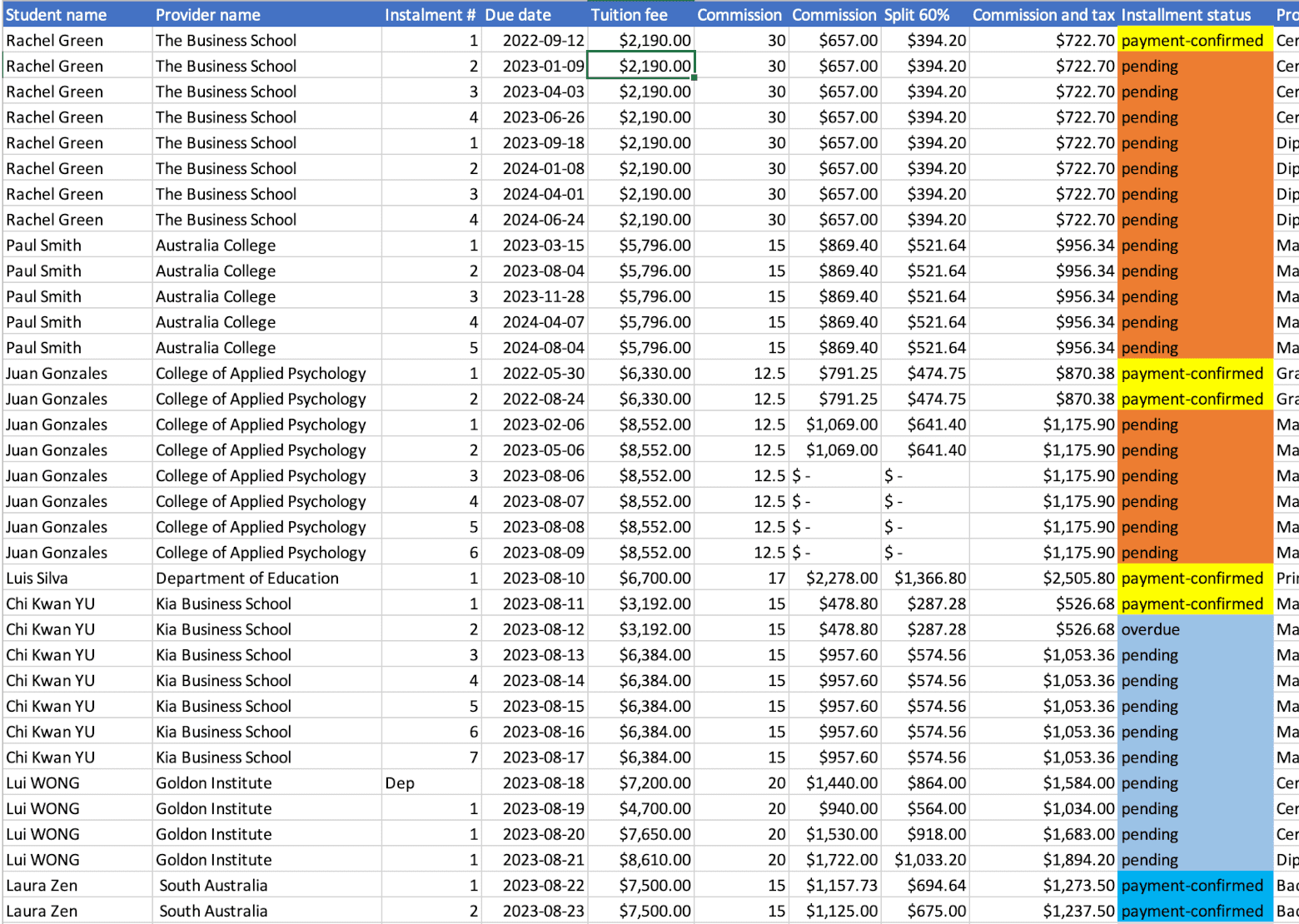
In the US, this is often called Self-Billing . Normally, the seller (Agent) sends an invoice to the buyer (School). But in education, the School knows exactly who enrolled and what they owe you. So, to save time, the School creates the invoice on your behalf and sends it to you with the payment.

  • Why it’s great: You don’t have to chase signatures.
  • Why it sucks: If their math is wrong, it’s a pain to fix.

Tax Invoice vs. Bill (The Xero Dilemma)

If you use accounting software like Xero or QuickBooks, this trips everyone up.

  • Tax Invoice: Use this when you are asking for money (Sending an invoice to a school for commission). In Xero, this is “Money Coming In” (Accounts Receivable).
  • Bill: Use this when you owe money (Paying the electricity or paying a Sub-Agent their share). In Xero, this is “Money Going Out” (Accounts Payable).

Common Mistake: Agents often enter a commission statement from a school as a “Bill” because it looks like a bill. But if it represents money coming to you, it’s an Invoice (or a Credit Note).

Reconciliation

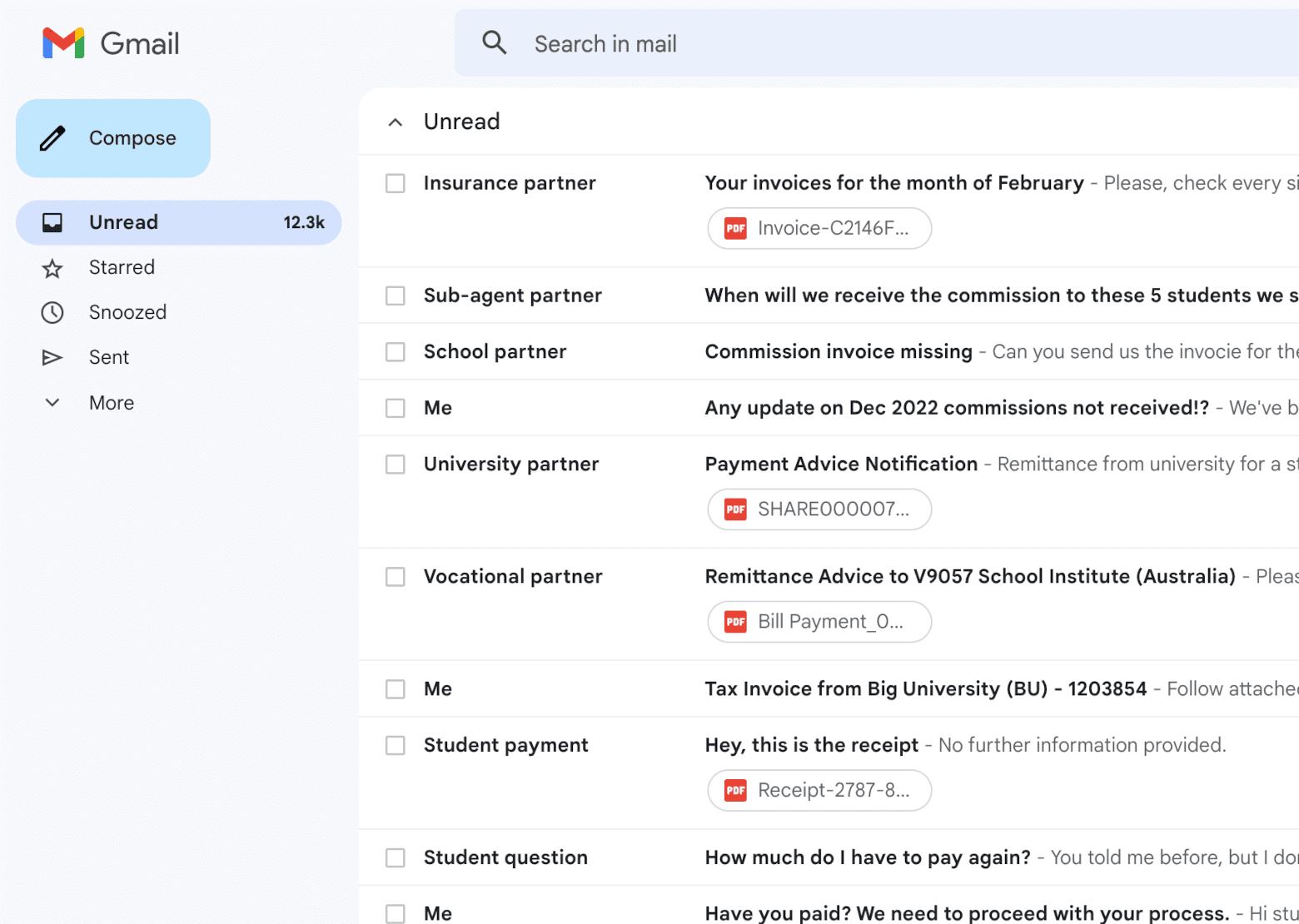
The detective work. This is the act of matching the money in your bank feed to the specific student or invoice it belongs to. The Nightmare Scenario: Receiving a lump sum of $50,000 for “Commissions” with no breakdown of which 20 students it covers.

Part 4: The Legacy & The Law

The “Book Rate” (or the Death of the Fixed Rate)

Years ago, agencies and schools sometimes used a “Book Rate” or a fixed exchange rate for a whole season (e.g., “We will accept 1 USD = 75 INR for all of 2015”). Some people also refer to legacy pricing structures like the “AITA Dollar” (an old concept from travel/IATA days regarding fixed exchange rates).

Reality Check: These are mostly dead. Volatility killed them. Today, almost everyone operates on Live Rates or Spot Rates . If you are promising parents a fixed exchange rate for next year, you are gambling with your own profit margin.

KYC and AML (The Fun Police)

  • KYC (Know Your Customer): Checking the ID of the person paying.
  • AML (Anti-Money Laundering): Checking the source of the money.
  • Source of Funds: A document agents often have to collect. Banks want to know if that $30,000 came from a salary, a property sale, or a loan. If you can’t prove it, the money gets frozen.

Sanction Screening

Before a university accepts a payment, they run the payer’s name against a global database (like the OFAC list) to ensure they aren’t a politician from a sanctioned country or a known criminal. If a student’s surname matches a known bad actor, the payment gets flagged for “Manual Review,” adding weeks to the process.

Pro-Rata Refund

If a student withdraws halfway through the term, they don’t get a full refund. They get a pro-rata refund based on how many weeks they attended. Agents need to understand this math, because the parents will definitely ask you why they only got 40% of their money back.

The Takeaway

Look, nobody gets into international education because they love reading bank ledgers. You do it for the students. You do it to see that lightbulb moment when a kid from a rural town realizes they can navigate a global city like London or Sydney.

But money is the fuel that makes those journeys possible.

When you understand the difference between a Master Agent and a Sub-Agent , or why an RCTI just landed in your inbox, you aren’t just memorizing definitions. You’re protecting your revenue. You’re ensuring your sub-agents get paid on time. You’re troubleshooting problems before they turn into angry phone calls.

So the next time a finance officer emails you about a “Reconciliation error on the Nostro regarding the Commission Clawback,” you don’t have to panic. You can smile and say, “I know exactly what that means. Let’s sort it out.”

And honestly? That is a pretty good feeling.

Light-speed payments & commissions.

The faster, smoother way to manage payments, for you, your students, and your partners.

  • For edudcation agents and schools
  • Receive tuition fees and manage commission automatically
  • Transparent fees